
Table of Contents
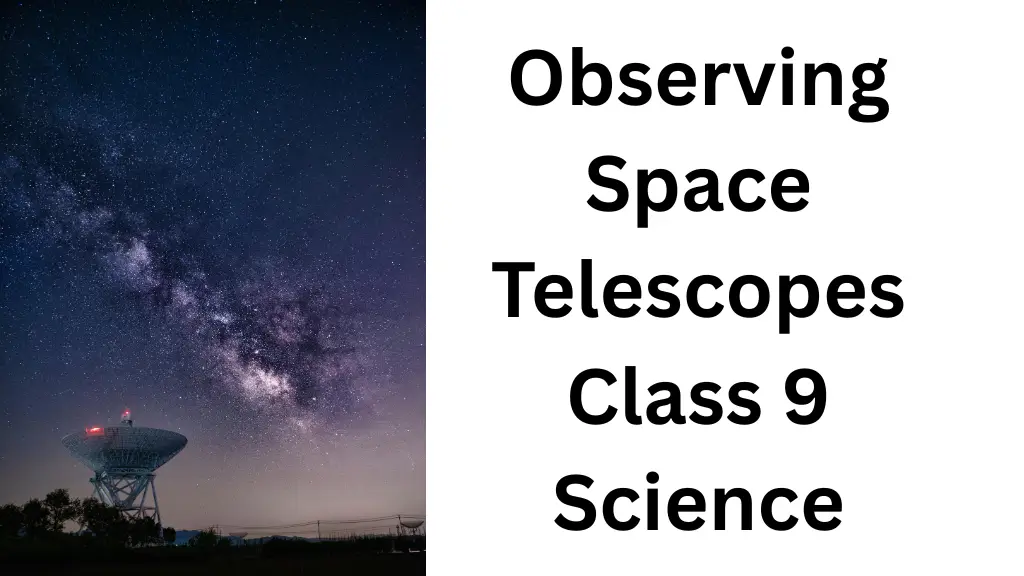
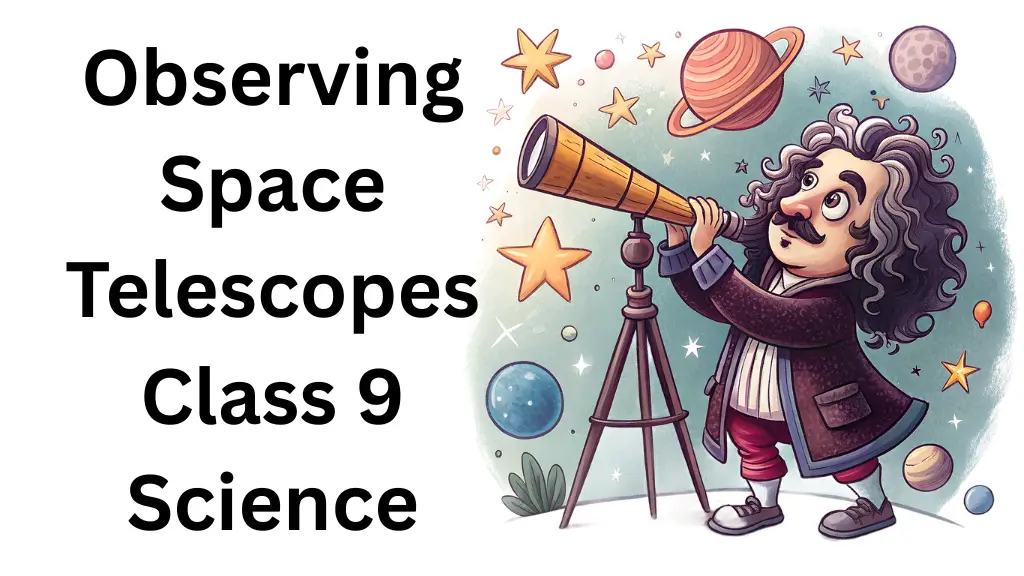
Observing Space Telescopes Class 9 Science
Observing Space: Telescopes is an important chapter in Class 9 Science that explains how humans study distant celestial objects using telescopes. The chapter covers the structure, working principles, and types of telescopes such as refracting, reflecting, and radio telescopes. It also highlights the importance of space observatories and how telescopes help in understanding stars, planets, galaxies, and the universe. This chapter builds scientific thinking and enhances students’ knowledge of astronomy and space science.
Chapter Overview – Observing Space Telescopes Class 9 Science
Humans cannot observe distant celestial bodies clearly with naked eyes. Telescopes help us collect more light and magnify faraway objects. Based on the type of radiation they detect, telescopes are classified into optical telescopes and radio telescopes.
Class 9 Science Chapter 18 Observing Space: Telescopes
Question Answer Maharashtra Board
1. Fill in the blanks with the proper words.
a. The wavelength of visible light is between …………………..….. and …………………..…. .
b. GMRT is used for …………………..….. waves.
c. A certain X-ray telescope is named after scientist …………………..…. .
d. The first scientist to use a telescope for space observations …………………..…. .
e. The biggest optical telescope in India is situated at …………………..…. .
2. Form pairs
| Column ‘A’ | Column ‘B’ |
| (1) X-rays | (a) GMRT |
| (2) Optical telescope | (b) ISRO |
| (3) Indian radio telescope | (c) Hubble |
| (4) Launching artificial-satellite | (d) Chandra |
Answer:
(1 – d),
(2 – c),
(3 – a),
(4 – b)
3. What are the difficulties in using ground-based optical telescopes? How are they overcome?
Answer:
Difficulties:
- The intensity of visible light coming from a heavenly body decreases due to absorption as it passes through the Earth’s atmosphere.
- Due to changes in atmospheric temperature and pressure light rays change their path.
- Because of sunlight, we cannot use optical telescopes during the day.
- During the night, city lights and cloudy weather cause difficulties.
Solution:
- To reduce these problems, optical telescopes are situated on top of mountains, in uninhabited places.
- To get rid of all the above problems completely, the telescope is placed above the earth’s atmosphere, in space.
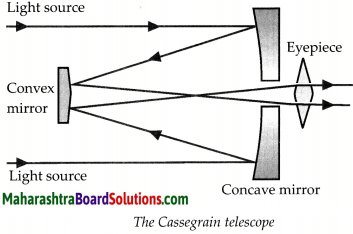
4. Which type of telescopes can be made using a concave mirror, convex mirror, plane mirror, and a lens? Draw diagrams of these telescopes.
Answer:
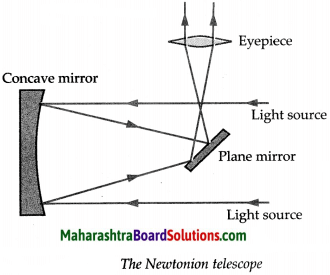
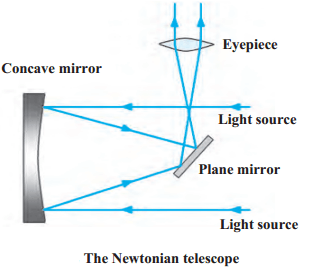
A Newtonian telescope can be made using a concave mirror, plane mirror and a lens.
A Cassegrain telescope can be made using a convex mirror, concave mirror and a lens.
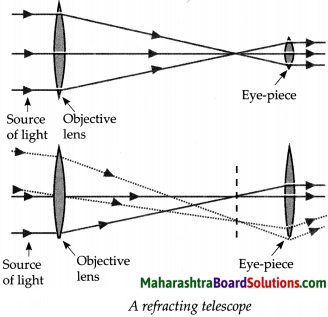
A refracting telescope can be made using two or more lenses.
5. Study the figure and answer the following questions:
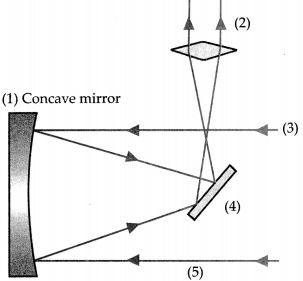
a. What type of telescope is shown in the figure?
b. Label the main parts of the telescope.
c. Which type of mirror does the telescope use?
d. What other type of telescope uses a curved mirror?
e. Explain the working of the above telescope.
Answer:
(a) The Newtonian telescope (Reflecting telescope)
(b)
(c) Concave mirror
(d) The Cassegrain telescope
(e) Working.
- Light rays coming from space are reflected by the concave mirror.
- Before these reflected rays converge at the focus, they are deflected again by a small plane mirror.
- As a result, they get focused at a point lying on the perpendicular to the axis of the telescope’s cylinder.
- They pass through the eyepiece and we get a magnified image of the source.
6. Answer the following questions.
a. Explain the construction of Galileo’s telescope.
Answer:
- The Galileo’s telescope is made up of two or more convex lenses.
- The lens facing the object is called the objective lens which is made as large as possible to collect the maximum amount of light coming from a heavenly object.
- The lens closer to the eye is called the eyepiece which uses the light collected by the objective lens and produces a large image of the source.
- Such a telescope is also called a refracting telescope.
b. Explain the construction of a radio telescope.
Answer:
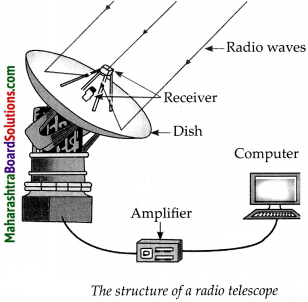
- The radio telescope is made from one or more dishes of a particular parabolic shape.
- As in optical telescope, the incident radio waves are reflected by these dishes and converge at the focus.
- A radio receiver is placed at the focal point.
- The information gathered by this receiver is passed on to a computer which analyses it and constructs an image of the source.
c. Why are optical telescopes located in uninhabited places on mountains?
Answer:
- The visible light coming from a heavenly body has to pass through the earth’s atmosphere to reach the earth’s surface.
- During this journey, some of the light is absorbed by the atmosphere and the intensity of the light reaching the earth’s surface decreases.
- A second problem is caused by the changes in atmospheric pressure and temperature.
- These changes cause turbulence in the atmosphere which in turn cause the light rays to change their path slightly and thereby shake the position of the image.
- We cannot use optical telescope during the day. because of sunlight also.
- During the night too, city lights and cloudy weather can cause difficulties in observing the heavenly bodies.
- Hence, optical telescopes are located in uninhabited places on mountains.
d. Why can an X-ray telescope not be based on the earth?
Answer:
- X-rays are emitted from distant heavenly bodies.
- The rays coming towards the earth will be absorbed by the earth’s atmosphere and will go undetected.
- Hence, X-ray telescopes are placed in an orbit outside the earth’s atmosphere and not on the earth.
Class 9 Science Chapter 18 Observing Space: Telescopes Extra Questions and Answers
Question 1. What is meant by space observation? Why is it important?
Answer:
The observation of distant planets, galaxies and other astronomical objects is called as space observation.
- Various space based satellites support our telecommunication networks by providing us television broadcasting.
- Meteorology services such as weather forecasting help in disaster management.
- Observation of positions of stars and other heavenly bodies has helped in the study of solar system, solar winds, pulsars, supernova, etc.
Class 9 Science Chapter 18 Observing Space: Telescopes Additional Important Questions and Answers
Choose and write the correct options:
Question 1. The first telescope was invented by
(a) Einstein
(b) Galileo
(c) Newton
(d) Mendel
Answer:
(b) Galileo
Question 2. Eight is an wave.
(a) electric
(b) magnetic
(c) electromagnetic
(d) mechanical
Answer:
(c) electromagnetic
Question 3. Visible radiation telescopes are also called as
(a) Gamma Ray telescopes
(b) Optical telescopes
(c) X-ray telescopes
(d) Radio telescopes
Answer:
(b) Optical telescope
Question 4. Reflecting telescopes are mainly of two types : ……………….. and ………………. .
(a) Newtonian and Galileoan
(b) Optical and Cassegrain
(c) Newtonian and Cassegrain
(d) Optical and Refracting
Answer:
(c) Newtonian and cassegrain
Question 5. Giant Meterwave Radio Telescope (GMRT) has been erected at near Pune.
(a) Asangaon
(b) Talegaon
(c) Narayangaon
(d) Bhategaon
Answer:
(c) Narayangaon
Question 6. Visible light coming from heavenly bodies have to pass through the to reach the earth surface.
(a) stratosphere
(b) troposphere
(c) atmosphere
(d) biosphere
Answer:
(c) atmosphere
Question 7. To collect the maximum amount of light coming from an object, the objective lens should be made as as possible.
(a) large
(b) small
(c) circular
(d) flat
Answer:
(a) large
Question 8. The images formed by lenses have errors of colours. This is called
(a) chromatic disruption
(b) chromatic aberration
(c) chromatic reflection
(d) chromatic reaction
Answer:
(b) chromatic aberration
Question 9. Radio telescope is made up of one or more dishes of shape.
(a) spherical
(b) hyperbolic
(c) parabolic
(d) hexagonal
Answer:
(c) parabolic
Match the columns:
Question 1.
| Column ‘A’ | Answer | Column ‘B’ |
| (1) X-rays | Chandra | (a) GMRT |
| (2) Optical telescope | Hubble | (b) ISRO |
| (3) Indian radio telescope | GMRT | (c) Hubble |
| (4) Launching artificial satellite | ISRO | (d) Chandra |
| (5) Radio waves | longer than 20cm | (e) telecommunication |
| (6) INSAT and GSAT | telecommunication | (f) longer than 20cm |
Question 2.
| Column ‘A’ | Answer | Column ‘B’ |
| (1) Micro waves (2) Infrared waves (3) Visible light rays (4) Ultraviolet rays (5) X-rays | 0.3 mm -20cm 800 nm – 0.3mm 400 nm – 800nm 360 pm – 400 nm 3 pm – 300 pm | (a) 800 nm – 0.3mm (b) 360 pm – 400 nm (c) 3 pm – 300 pm (d) 400 nm – 800nm (e) 0.3 mm -20cm |
Answer the following:
Question 1. How do refracting telescopes work?
Answer:
- Most refracting telescopes are made with two or more lenses.
- The two lenses are called objective lens and an eyepiece lens.
- The objective lens should be large so that maximum light can be collected from the source.
- Using the light collected, the eyepiece lens which is small in size, produces a large image of the source.
Question 3. How does a radio telescope work?
Answer:
- A radio telescope is made from one or more dishes of a particular parabolic shape.
- The incident radio waves are reflected by these dishes and converge at a focus.
- A radio receiver is placed at focal point.
- The information gathered by this receiver is then passed onto a computer which analyses and constructs the image of the source.
Chandra was launched to study X-rays coming from heavenly objects. Special mirrors which . can reflect X-rays were used in this telescope.
Answer the following:
Question 1. State some of the satellites and their uses.
Answer:
- The INSAT and GSAT series of satellites support our telecommunication network, television broadcasting and meteorological services.
- It is because of them that telephone, television and internet services are available everywhere in the country.
- The EDUSAT satellite is used exclusively for education.
- The IRS satellite series is used for the monitoring and management of natural resources as well as disaster management.
- Astrosat: It has ultraviolet and X-ray telescopes and detectors. It is a unique system having different kinds of telescopes on a single satellite.
Question 2. What is the specialty of the artificial satellite Astrosat?
Answer:
- This satellite was launched by Indian Space Research Organization (ISRO).
- It has ultraviolet and X-ray telescopes and detectors. Most of the parts used in this satellite are made in India.
- It is an unique system having different kinds of telescopes on a single satellite. Indian scientists are studying various aspects of the Universe using the data obtained with these telescopes.
Answer in detail:
Question 1. Explain any two space observation telescope.
Answer:
Hubble Telescope:
- In 1990, the National Aeronautics and Space Administration launched into space an optical telescope called the Hubble telescope.
- It has a mirror of diameter 94 inches and is orbiting the earth at a height of 589 km from it.
- This telescope is still working and has helped to make important discoveries.
Chandra Telescope:
- In 1999, the National Aeronautics and Space Administration launched an X-ray telescope named Chandra, in space, to study X-rays coming from heavenly objects.
- Special mirrors which can reflect X-rays were used in this telescope.
- Chandra has given us very useful information about stars and galaxies.
- The telescope is named after the famous Indian scientist Subramanian Chandrashekhar.
Refracting and Reflecting Telescope
Question 2.
Write short note : GMRT
Answer:
- Giant Meterwave Radio Telescope (GMRT) is a large radio telescope erected at Narayangaon near Pune.
- It uses radio waves having wavelengths of about a metre, coming from heavenly bodies to study those bodies. This telescope is actually a collection of 30 dishes, each having a diameter of 45 m.
- It is called a giant telescope as the arrangement of the 30 dishes over an area which measures up to 25 km across. It works as a single dish having a diameter of 25 km.
- GMRT gives the same data that we would have got from a telescope having a single dish of 25 km diameter.
- Scientists study the solar system, solar winds, pulsars, supernova, interstellar hydrogen clouds, etc. with the help of the GMRT.
Observing Space Telescopes Class 9 Science
🔭 Types of Telescopes Explained: –
- Refracting Telescope
- Uses lenses
- Suffers from chromatic aberration
- Limited size
- Reflecting Telescope
- Uses mirrors
- No chromatic aberration
- Used in large observatories
- Radio Telescope
- Detects radio waves from space
- Works day and night
- Helps study galaxies and pulsars
🌍 Space Observatories:
- Located outside Earth’s atmosphere
- Give clearer images
- Example: Hubble Space Telescope
📝 Frequently Asked Questions (FAQs) – Observing Space Telescopes Class 9 Science
❓ What is a telescope?
A telescope is an optical instrument used to observe distant celestial objects by collecting and focusing light.
Telescope types Class 9 Science
❓ Why are reflecting telescopes preferred over refracting telescopes?
Reflecting telescopes do not suffer from chromatic aberration and can be made much larger.
❓ What is chromatic aberration?
It is the splitting of white light into different colours while passing through a lens.
❓ What is the role of radio telescopes?
Radio telescopes detect radio waves emitted by celestial bodies and help study invisible objects.
❓ Why are space telescopes better than Earth-based telescopes?
They are free from atmospheric disturbances, providing clearer images.
🧠 Exam-Oriented Important Points – Observing Space Telescopes Class 9 Science
- Telescopes increase light-gathering power
- Larger aperture → better resolution
- Atmosphere causes distortion
- Mirrors are better than lenses
- Radio astronomy reveals hidden universe
📊 MCQ Sample (For Practice) – Observing Space Telescopes Class 9 Science
Observing Space Maharashtra Board
Q. Which telescope uses mirrors?
a) Refracting
b) Reflecting ✅
c) Radio
d) Optical
📌 Educational Importance – Observing Space Telescopes Class 9 Science
- Builds interest in astronomy
- Improves conceptual understanding
- Helpful for SSC Board exams
- Strengthens scientific observation skills