
Table of Contents
Biotechnology Chapter 17 Class 9 Science Notes
What is Biotechnology?
Biotechnology is the application of biological organisms, cells or enzymes to develop useful products for human welfare.
It combines biology + technology to improve agriculture, medicine, industry and environment.
🧬 Main Areas of Biotechnology
- Medical Biotechnology – insulin, vaccines, antibiotics
- Agricultural Biotechnology – high-yield crops, pest-resistant plants
- Industrial Biotechnology – enzymes, fermented products
- Environmental Biotechnology – waste treatment, pollution control
🧪 Important Concepts
- Genetic Engineering
- Recombinant DNA Technology
- Use of microorganisms
- Bioprocess technology
- Role of enzymes
1. Each of the following statements is wrong. Rewrite them correctly by changing either one or two words.
a. Simple squamous epithelium is present in the respiratory tract.
b. Glandular epithelium is present in kidneys.
c. Chlorenchyma helps the plant to float in water.
d. Striated muscles are also called involuntary muscles.
e. Chloroplast is present in permanent tissue.
Answer:
a. False. Ciliated columnar epithelium is present in respiratory tract.
b. False. Cuboidal epithelium is present in kidneys.
c. False. Aerenchyma helps the plant to float in water.
d. False. Striated muscles are also called voluntary muscles.
e. False. Chlorenchyma is present in permanent tissue.
2. Identify the odd word and explain why it is odd.
a. Xylem, phloem, permanent tissue, meristematic tissue.
Answer:
Meristematic tissue. It has the ability to divide whereas the others have lost the ability to divide.
b. Epithelium, Muscle fibre, nerve fibre, the epidermis.
Answer:
Epidermis. It is a plant tissue whereas the others are animal tissues.
c. Cartilage, bone, tendon, cardiac muscle.
Answer:
Cardiac muscle. It is a muscular tissue whereas the others are connective tissues.
Biotechnology Chapter 17 Class 9 Science Notes
3. Write the names of the following tissues.
a. Tissue lining inner surface of mouth.
Answer:
Squamous epithelium.
b. Tissue joining muscles and bones.
Answer:
Tendon
c. Tissue responsible for increasing height of plants.
Answer:
Apical meristem.
d. Tissue responsible for increasing girth of stem.
Answer:
Lateral meristem.
4. Write the differences.
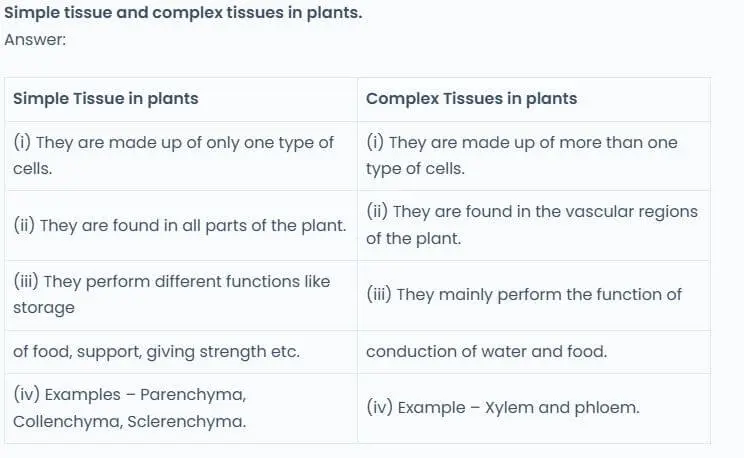
Simple tissue and complex tissues in plants.
Answer:
| Simple Tissue in plants | Complex Tissues in plants |
| (i) They are made up of only one type of cells. | (i) They are made up of more than one type of cells. |
| (ii) They are found in all parts of the plant. | (ii) They are found in the vascular regions of the plant. |
| (iii) They perform different functions like storage | (iii) They mainly perform the function of |
| of food, support, giving strength etc. | conduction of water and food. |
| (iv) Examples – Parenchyma, Collenchyma, Sclerenchyma. | (iv) Example – Xylem and phloem. |
5. Write short notes. – Biotechnology Chapter 17 Class 9 Science Notes
a. Meristematic tissue.
Answer:
- Meristematic tissue is present in specific parts of a plant where growth takes place.
- Cells of meristematic tissue contain thick cytoplasm, a conspicuous nucleus and a thin cell wall and are compactly packed together.
- Vacuoles are usually absent in these cells and they are highly active.
- The main function of meristematic tissue is to bring about plant growth.
- According to the location, meristematic tissues are of three types: Apical meristem, intercalary meristem and lateral meristem.
b. Xylem
Answer:
- Xylem is a complex permanent tissue in plants.
- It consists of thick-walled dead cells.
- The type of cells in xylem are trachieds, vessels, xylem fibres (dead cells) and xylem parenchyma (living cells).
- Its structure is like interconnected tubes conduct water and minerals only in upward direction.
c. Striated muscles.
Answer:
- The cells of striated muscles are long, cylindrical, multinucleate and have no branches.
- These are alternate dark and light bands on these muscles.
- As they are attached to bones, they are also called skeletal muscles.
- They move as per our will, hence they are called voluntary muscles.
- Striated muscles bring about movements of arms and legs, running, speaking etc.
d. Agro-complementary business.
Answer:
(i) The business that are complementary to agriculture and generate supplementary income for the farmers are called agro complementary business.
(ii) These include:
- Animal Husbandry: It is practiced for milk production and for using the cattle as help in farming operations, e.g. cows and buffaloes are raised for milk whereas bulls and male buffaloes for pulling heavy loads.
- Poultry farming: It is the rearing of egg and meat yielding chickens. Chickens raised for eggs are called layers while those raised for meat are called broilers.
- Sericulture: It is the rearing of silkworms (moths) for silk production. The silk fibres obtained are processed, reeled and then woven into fabric.
e. Genetic engineering
Answer:
- Genetic engineering is the deliberate modification of the characteristics of an organism by manipulating its genetic material.
- An organism that is generated through genetic engineering is called a genetically modified organism (GMO).
- Genetic engineering is applied in many fields like research, agriculture, industrial biotechnology and medicine.
- In agriculture, genetic engineering is used in the production of cash crops, improvement in varieties of cash crops, increase in ability of plants to withstand environmental stresses.
- In medicine, genetic engineering is used for vaccine production, early diagnosis of congenital disease, organ transplant, cancer research, production of artificial skin, cartilage etc. in laboratories.
f. Sericulture
Answer:
- Sericulture is the rearing of silkworms (moths) for production of silk.
- Bombyx mori is the most commonly used variety of silkworm for this purpose.
- The life cycle of silkworm consist of four stages namely egg, larva, pupa and adult.
- Thousands of eggs deposited by female moths are incubated artificially to shorten the incubation period.
- Larvae hatching out of eggs are released on mulberry plants.
- Larvae are nourished by feeding on mulberry leaves.
- After feeding for 3-4 days, larvae move to branches of mulberry plant.
- The silk thread is formed from the secretion of their salivary glands.
- Larvae spin this thread around themselves to form a cocoon. The cocoon may be spherical in nature.
- Ten days before the pupa turns into an adult, all the cocoons are transferred into boiling water.
- Due to the boiling water, the pupa dies in the cocoon and silk fibres become loose.
- These fibres are unwound, processed and reeled. Various kinds of fabric is woven from silk threads.
6. Explain the meaning of biotechnology and its impact on agricultural management with suitable examples.
Answer:
The techniques of bringing about improvements in living organisms by artificial genetic changes and by hybridization for the welfare of human beings, are together called biotechnology. Impact of biotechnology on agricultural management:
- Genetically modified crops (GM crops) are being produced by introducing changes in DNA of natural crops.
- Normally such varieties are not found in nature.
- Thus, new varieties are produced artificially Different useful characters are introduced in such varieties.
- Some naturally occurring varieties cannot withstand environmental stress like frequently changing temperature.
- Wet and dry famines, changing climates etc. However, GM crops can grow in any of such adverse conditions.
- As GM crops are resistant to insect pests, pathogens, chemical weedicides, etc. the use of harmful chemicals like pesticides can be avoided.
- Due to use of seeds of GM crops, there is improvement in nutritive value and decrease in loss of crops.
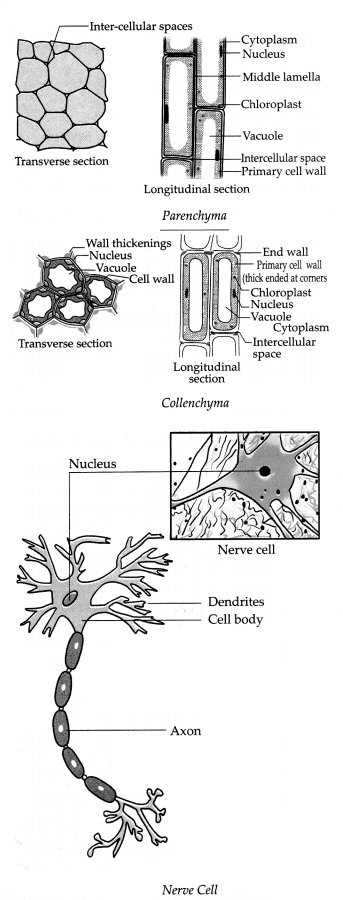
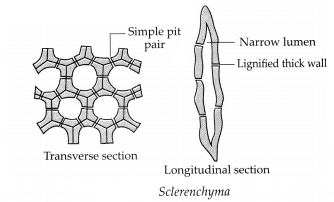
Draw neat and labelled diagrams of the following:
7. Which two main techniques are used in biotechnology? Why?
Answer:
- The two main techniques used in biotechnology are – Genetic engineering and tissue culture.
- These techniques are used to bring about improvements in living organisms by artificial genetic changes and by hybridization for the welfare of human beings.
- Its uses are in the production of cash crops, improvement in varieties of cash crops, early diagnosis of congenital diseases, organ transplant, cancer research, production of artificial skin, cartilage etc. in laboratories.
8. Discuss ‘Agritourism’ in the class and write a project on an agrotourism centre nearby. Present it in the class in groups.
Answer:
- In agritourism, plantlets of flowering, medicinal, ornamental, vegetable plants and fruit trees are produced on a large scale by tissue culture technique.
- By growing some of the plants fully, an agritourism centre can be developed.
- If sufficient land is available, the emerging field of agritoursim would be a good business.
- An agritourism centre consists of following:
(a) Mango, chikoo (sapota), guava, coconut, custard apple and some other regional fruit trees.
(b) Shade giving local or exotic attractive plants.
(c) Ornamental and flowering plants.
(d) Butterfly garden.
(e) Medicinal plant garden.
(f) Organic vegetables and fruits. - People visit places with such attraction in large numbers.
- Selling plantlets/seedlings, fruits, vegetables at such places can be quite profitable.
9. Define the term tissue and explain the concept of tissue culture.
Answer:
A group of cells having the same origin, same structure and same function is called tissue. Concept of tissue culture:
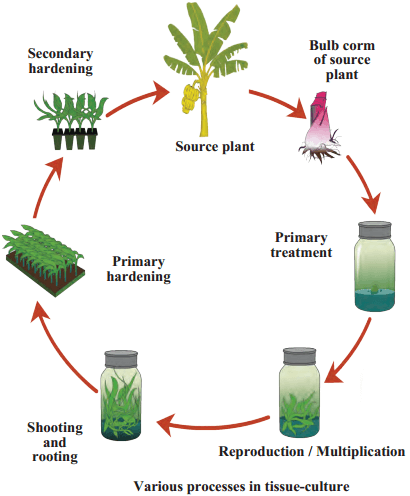
- Ex vivo growth of cells or tissues in an aseptic and nutrient-rich medium is called tissue culture.
- Nowadays, a complete organism can be developed from a single cell or from tissue with the help of the tissue culture technique.
- A liquid, solid or gel-like medium prepared from agar, which supplies nutrients and energy necessary for tissue culture is used in this technique.
- Tissue culture can be used to grow plants on a large scale, which bear flowers, fruits of excellent quality, in shorter durations and are disease free.
- The various processes involved in tissue culture are:
0. ‘Rearing of sheep is a livestock’. Justify this statement.
Answer:
- The term livestock refers to animals reared for profit or for use.
- Sheep provides us with wool, skin, meat and milk.
- Therefore, rearing of sheep is a livestock.
Chapter 17 Biotechnology Important Questions
Class 9 Science Chapter 17 Introduction to Biotechnology Intext Questions and Answers
Question 1.
Which components bring about important processes in the living organisms?
Answer:
Cells, tissues, organs, organ systems bring out important processes in living organisms.
Question 2.
You must have seen flowers of same variety but of 2 or 3 different colours borne by same plant. How is this possible?
Answer:
- The different coloured flowers borne by the same plant are due to the pigments like anthocyanins, carotenoids etc. according to the genetic makeup of the plant.
- Also, by using the latest techniques of biotechnology and tissue culture, it is possible to manipulate the genes for flower colour and get the desired flower colour.
Question 3.
Why do slim persons feel more cold in winter than those who are obese?
Answer:
- Below the skin, there is a tissue called adipose tissue.
- The cells of these tissue are filled with fat droplets.
- Due to storage of fat, it acts as an insulator and helps to retain heat in the body.
- Obese people have more fat deposited in the adipose tissue as compared to slim persons. Therefore, slim persons feel more cold in winter than those who are obese.
Question 4.
Why can bones not be folded?
Answer:
- Bone cells called osteocytes are embedded in solid ground substance made up of calcium phosphate.
- This makes the bone hard, rigid and non- flexible. Therefore, bones cannot be folded.
Why we cannot see our organs like the heart, blood vessels and intestines?
Answer:
We cannot see our organs like the heart, blood vessels and intestines as they are located inside the body.
Question 5
What is meant by white revolution? Who was its pioneer? What benefits did it bring?
Answer:
- White revolution was the programme launched by the National Dairy Development Board to increase the milk production in India.
- Dr. Verghese Kurien was the pioneer of white revolution.
- It transformed India from a milk-deficient nation to the largest producer of milk. It also helped the dairy farmers in directing their own development and empowering them.
It also helped to reduce the malpractices carried out by milk traders and merchants.
Are the structure and functions of the bodies of plants and animals the same?
No. The structure and functions of the bodies of plants and animals are not the same. Some differences between plants and animals:
Answer:
| Plants | Animals |
| Plants continue to grow throughout their life. | Animals grow only for a specific period of life. |
| Growth in plants in not uniform. | Growth in animals is uniform. |
| Plants have dividing and non-dividing tissues. | Animals do not have different dividing and nondividing tissues. |
| Plants are sedentary. | Animals generally move from place to place in search of food, shelter and partners. |
| Energy needs of plants are less. | Energy needs of animals are greater. |
| Plants can prepare their own food by photosynthesis. | Animals cannot prepare their own food. They depend on plants and other animals for their food. |
Question 6.
Explain the types of complex permanent tissues.
Answer:
| Name of tissue | Xylem | Phloem |
| Characteristics | Consists of thick-walled dead cells | Consists of cytoplasm containing living cells. |
| Types of cells | Tracheids, vessels and xylem fibres – dead cells. Xylem parenchyma – living cells. | Sieve tubes, companion cells, phloem parenchyma – living cells. Phloem fibres – dead cells. |
| Function | A structure like interconnected tubes, conduct water and minerals only in upward direction. | Tubes joined to each other, conduct sugar and amino acids from leaves to various parts in upward and downward direction |
Question 7
Blood is a complex tissue.
Answer:
- A complex tissue is made up of more than one type of cells.
- In blood, cells of different types, colour and shapes are mixed together.
- Blood contains erythrocytes (RBCs), leucocytes (WBCs) and platelets in a liquid plasma.
- Therefore, blood is a complex tissue.
Question 8 Describe the structure of nervous tissue with the help of a neat labelled diagram.
Answer:
- Nervous tissue enables us to respond to stimuli like touch, sound, odour, colour, etc.
- Cells of the nervous tissue are specifically made to become excited and conduct the excitation from one part of the body to another.
- The main part of the nerve cell is the cell body which contains the cytoplasm and the nucleus.
- Numerous, small, branched fibres called dendrites arise from the cell body.
- One of the fibres, is extremely long and is called
the axon. - The length of the nerve cell may be up to one metre.
- Many nerve cells are bound together with the help of connective tissue to form a nerve.
- Nervous tissue is present in the brain, spinal cord and the network of nerves spread all throughout the body.
- In most animals, action in response to a stimulus occurs due to the integrated functioning of the nervous tissue and muscular tissue.
📝 Chapter 17 Biotechnology Important Questions
Q. Define biotechnology.
Answer:
Biotechnology is the use of biological systems or organisms to develop products beneficial to humans.
Q. Name any two biotechnological products.
Answer:
Insulin and vaccines.
Q. What is recombinant DNA?
Answer:
DNA formed by combining DNA from two different organisms.
📖 Long Answer Question – Biotechnology Chapter 17 Class 9 Science Notes
Explain the importance of biotechnology.
Answer:
Biotechnology plays a vital role in medicine by producing vaccines and life-saving drugs like insulin.
In agriculture, it increases crop yield and resistance to pests.
In industry, enzymes are used for fermentation and manufacturing.
Environmental biotechnology helps in treating waste and reducing pollution.
Thus, biotechnology improves quality of life and supports sustainable development.
🧠 MCQs – Introduction to Biotechnology
1. Biotechnology is a combination of:
A) Physics and Chemistry
B) Biology and Technology ✅
C) Chemistry and Maths
D) Biology and Physics
2. Insulin is produced using:
A) Fermentation
B) Genetic Engineering ✅
C) Photosynthesis
D) Respiration
3. Who is the father of biotechnology?
A) Mendel
B) Darwin
C) Karl Ereky ✅
D) Watson
4. Which is NOT an application of biotechnology?
A) Vaccine production
B) Crop improvement
C) Electricity generation ✅
D) Waste treatment
📌 Other Important Points
✔ Chapter is MCQ-heavy
✔ Definitions are very important
✔ Applications questions frequently asked
✔ Suitable for 1, 2, 3 & 5 mark questions
🎯 Exam Tip (Maharashtra Board)
👉 Focus on:
- Definitions
- Applications
- One-word answers
- MCQs
📝 Important Short Answer Questions
Q. Define biotechnology.
Answer:
Biotechnology is the use of biological systems or organisms to develop products beneficial to humans.
Q. Name any two biotechnological products.
Answer:
Insulin and vaccines.
Q. What is recombinant DNA?
Answer:
DNA formed by combining DNA from two different organisms.
📖 Long Answer Question – Std 9 Biotechnology MCQ with Answers
Explain the importance of biotechnology.
Answer:
Biotechnology plays a vital role in medicine by producing vaccines and life-saving drugs like insulin.
In agriculture, it increases crop yield and resistance to pests.
In industry, enzymes are used for fermentation and manufacturing.
Environmental biotechnology helps in treating waste and reducing pollution.
Thus, biotechnology improves quality of life and supports sustainable development.
🧠 MCQs – Introduction to Biotechnology
1. Biotechnology is a combination of:
A) Physics and Chemistry
B) Biology and Technology ✅
C) Chemistry and Maths
D) Biology and Physics
2. Insulin is produced using:
A) Fermentation
B) Genetic Engineering ✅
C) Photosynthesis
D) Respiration
3. Who is the father of biotechnology?
A) Mendel
B) Darwin
C) Karl Ereky ✅
D) Watson
4. Which is NOT an application of biotechnology?
A) Vaccine production
B) Crop improvement
C) Electricity generation ✅
D) Waste treatment
📌 Other Important Points – Biotechnology Class 9 Notes Maharashtra Board
✔ Chapter is MCQ-heavy
✔ Definitions are very important
✔ Applications questions frequently asked
✔ Suitable for 1, 2, 3 & 5 mark questions
🎯 Exam Tip (Maharashtra Board)
👉 Focus on:
- Definitions
- Applications
- One-word answers
- MCQs
❓ Frequently Asked Questions (FAQ)
Q1. What is biotechnology?
Answer:
Biotechnology is a branch of science that uses living organisms or their parts to produce useful products.
Q2. Who is called the father of biotechnology?
Answer:
Karl Ereky is known as the father of biotechnology.
Q3. What is genetic engineering?
Answer:
Genetic engineering is the technique of altering genes to obtain desired traits in organisms.
Q4. Give two applications of biotechnology.
Answer:
- Production of insulin
- Development of disease-resistant crops
Q5. Is biotechnology useful for environment?
Answer:
Yes, it helps in waste management, sewage treatment and pollution control.