

Table of Contents
9th Science Notes Maharashtra Board Part 11
Science Chapter 11 Reflection of Light Class 9
a. Explain the difference between a plane mirror, a concave mirror and a convex mirror with respect to the type and size of the images produced.
Answer:
| Mirror Type | Type of Image | Size of Image |
| Plane mirror | Virtual and Erect | Same size |
| Concave mirror | Virtual (erect) as well as Real (inverted) | Diminished, same size and magnified |
| Convex mirror | Virtual and Erect | Diminished |
b. Describe the positions of the source of light with respect to a concave mirror.
- (a) Torch light: The source of light is placed at the focus.
- (b) Projector lamp: The source is placed at the centre of curvature.
- (c) Flood light: The source is placed just beyond the centre of curvature.
c. Why are concave mirrors used in solar devices?
notes for class 9 science : Answer:
- Solar devices like solar cooker or solar water heater use solar energy to cook food or heat water.
- When sun rays fall on the concave mirror, they converge and come together in the focal plane.
- Due to convergence, the intensity of sun rays increases and the food or water is heated faster. Hence, concave mirrors are used in solar- devices.
d. Why are the mirrors fitted on the outside of cars convex?
Answer:
• Convex mirrors form erect, virtual and diminished images.
• They give a wider field of view.
• Thus, the driver can see a large area behind.
e. Why does obtaining the image of the sun on a paper with the help of a concave mirror burn the paper?
Answer:
- When sunrays fall on the concave mirror, they converge and come together in the focal plane.
- Due to convergence, the intensity of sunrays increases.
- Hence, image of the sun on a paper with the help of concave mirror bums the paper.
Read : Chapter 12th: Part 12 Study of Sound 9th Science Notes
f. If a spherical mirror breaks, what type of mirrors are the individual pieces?
Answer:
- When a spherical mirror breaks into smaller pieces, the radius of curvature and focal length does not change.
- Hence, it will continue to behave like a spherical mirror only.
2. What sign conventions are used for reflection from a spherical mirror?
Answer:
According to the Cartesian sign convention, the pole of the mirror is taken as the origin. The principal axis is taken as the X-axis of the frame of reference. The sign conventions are as follows.
- The object is always kept on the left of the mirror. All distances parallel to the principal axis are measured from the pole of the mirror.
- All distances measured towards the right of the pole are taken to be positive, while those measured towards the left are taken to be negative.
- The distance measured vertically upwards from the principal axis are taken to be positive.
- The distance measured vertically downwards from the principal axis are taken to be negative.
- The focal length of a concave mirror is negative while that of a convex mirror is positive.
According to the Cartesian sign convention:
- Object is kept on the left of the mirror.
- Distances to the right of pole → positive, to the left → negative.
- Distance measured upward → positive.
- Downward → negative.
- Focal length of concave mirror → negative, convex → positive.
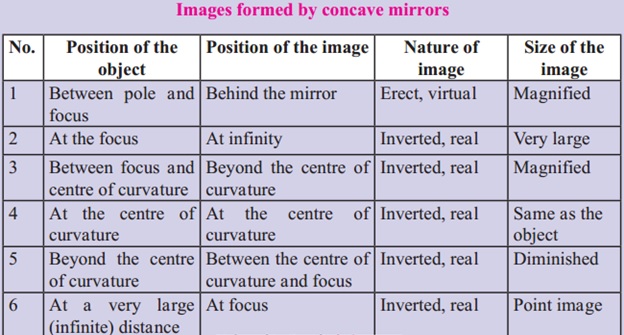
3. Draw ray diagrams for the cases of images obtained in concave mirrors as described in the table on page 122.
(a) A ray diagram for object at infinity for a concave mirror. – Object at Infinity
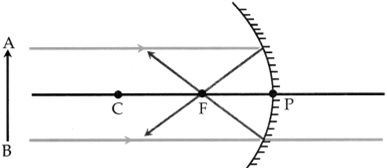
| Image position | Nature of image |
| At focus of Concave Mirror | Real, inverted and highly diminished. |
(b) A ray diagram for object beyond centre of curvature for a concave mirror. – Object between infinity and C.
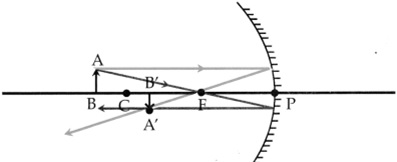
An object beyond centre of curvature for a concave mirror
| Image position | Nature of image |
| Between the centre of curvature and focus. | Real, inverted and diminished. |
(c) A ray diagram for object at the centre of curvature for a concave mirror.
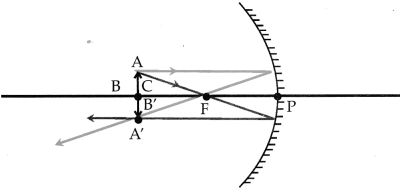
Object at centre of Curva fu re be a concave mirror.
| Image position | Nature of image |
| At the centre of curvature. | Real, inverted and same size |
(d) A ray diagram for object between F and C for a concave
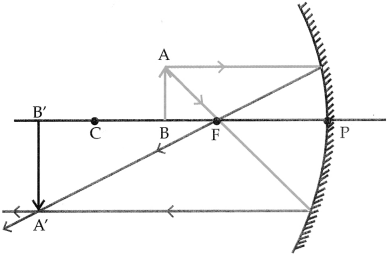
Object between F & C for a concave mirror
| Image position | Nature of image |
| Beyond the centre of curvature. | Real, inverted and magnified. |
(e) A ray diagram for obj ect at focus for a concave mirror.
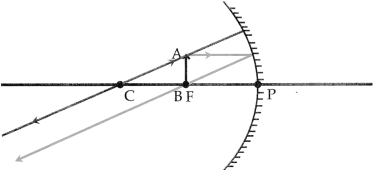
Object at focus for a concave mirror.
| Image position | Nature of image |
| At infinity. | Real, inverted and highly magnified. |
(f) A ray diagram for object between pole and focus for a concave mirror.
| Image position | Nature of image |
| Behind the mirror. | Virtual, erect and magnified. |
4. Which type of mirrors are used in the following?
Periscope, floodlights, shaving mirror, kaleidoscope, street lights, headlamps of a car.
Answer:
| Object | Type of Mirror |
| Periscope | Plane mirror |
| Floodlights | Concave mirror |
| Shaving mirror | Concave mirror |
| Kaleidoscope | Plane mirror |
| Street lights | Convex mirror |
| Headlamps of car | Concave mirror |
5. Solve the following examples a. An object of height 7 cm is kept at a distance of 25 cm in front of a concave mirror. The focal length of the mirror is 15 cm. At what distance from the mirror should a screen be kept so as to get a clear image? What will be the size and nature of the image?
Solution:
Given: Object size (h1) = 7 cm
Object distance (u) = -25 cm
Focal length (f) = -15cm
To find: Image distance (u) = ?
Image size (h2) = ?
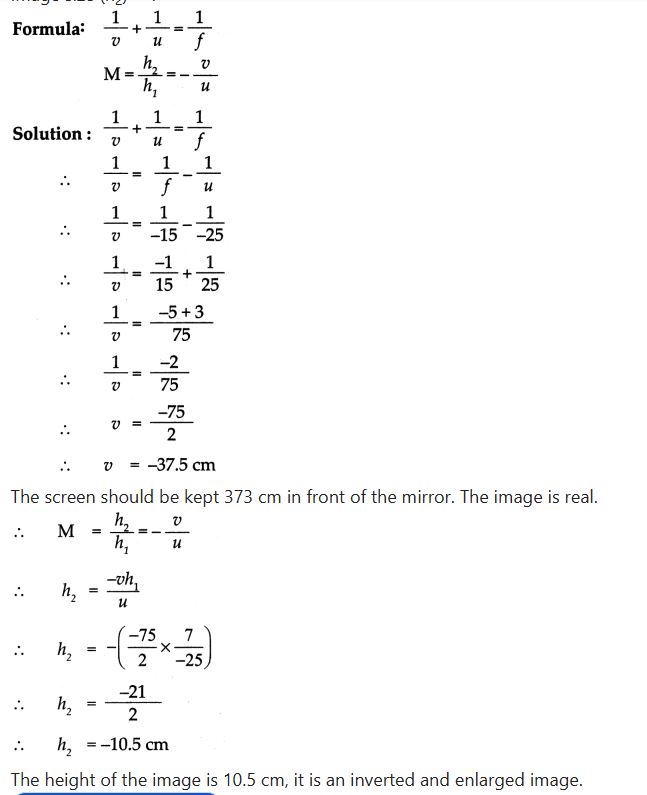
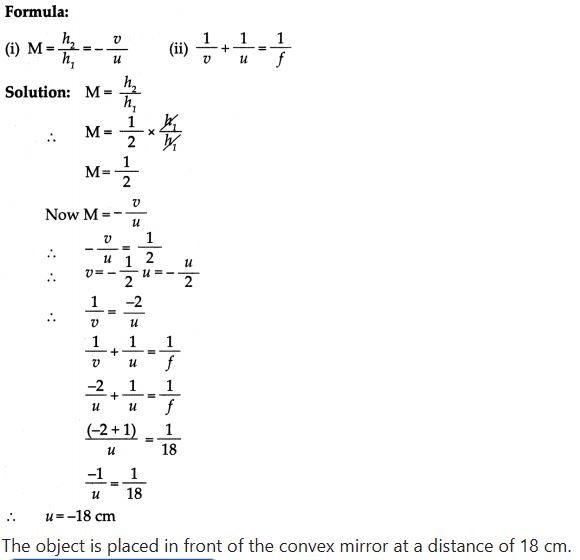
b. A convex mirror has a focal length of 18 cm. The image of an object kept in front of the mirror is half the height of the object. What is the distance of the object from the mirror?
Solution:
Given: Image size (h2) = 1/2 h1
Focal length (f) = 18 cm
To find: Object distance (u) ?
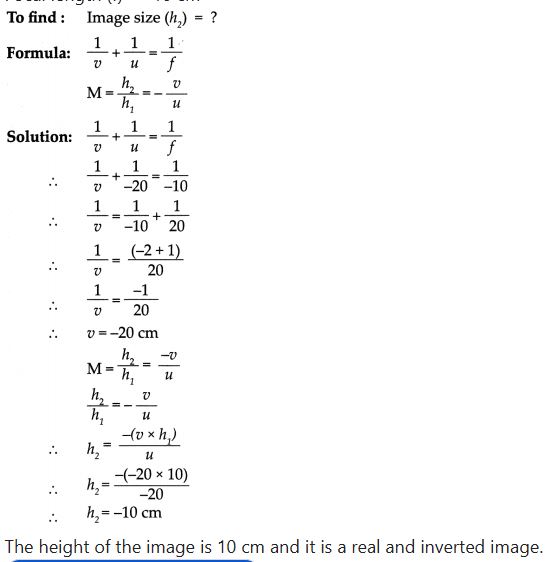
c. A 10 cm long stick is kept in front of a concave mirror having focal length of 10 cm in such a way that the end of the stick closest to the pole is at a distance of 20 cm. What will be the length of the image?
Solution:
Given: Object size (h1) = 10 cm
Object distance (u) = -20 cm
Focal length (f) = -10 cm
6. Three mirrors are created from a single sphere. Which of the following:
pole, centre of curvature, radius of curvature, principal axis – will be common to them and which will not be common?
Answer:
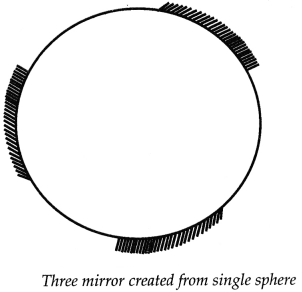
- Centre of curvature and Radius of curvature will be common for all three pieces.
- Pole and Principal axis will not be common.
Extra Question of Chapter 11 Reflection of Light:
Class 9 Science Chapter 11 Reflection of Light Intext Questions and Answers
- What is light
Answer:
Light is a form of electromagnetic radiation that allows us to see things around us.
2. What is a mirror?
Answer:
A mirror is a surface which reflects light and creates clear images.
3. Which letters of the English alphabet form images that look the same as the original letters?
Answer:
A, H, I, M, O, T, U, V, W, X, Y
4. When a person stands in front of a plane mirror, how is the image formed? What is the nature of the image?
Answer:
- The image of a person is formed from every point of the source, thereby forming an extended image of the whole source.
- The image formed would be virtual, upright and left-right reversed.
5. What is meant by reflection of light and what are the types of reflection?
Answer:
The bouncing back of light when it hits an opaque surface is called reflection of light. The two types of reflection are regular and irregular reflection.
6. What are the laws of reflection.
Answer:
- The incident ray, reflected ray and normal all lie in the same plane at the point of incidence.
- The angle of incidence is equal to the angle of reflection.
- The incident ray and the reflected ray lie on opposite sides of the normal.
7. What kind of mirror will a doctor use to concentrate on teeth, eyes, ears etc.?
Answer:
The doctor will use a concave mirror to concentrate on teeth, eyes, ears etc.
8. What are the two types of spherical mirror?
Answer:
Convex mirror and concave mirror are the two types of spherical mirror.
9. Why Concave mirrors are used in torches and in car headlights.
Answer:
- Concave mirrors are used in torches and car headlights because when a source of light is placed at the focus of a concave mirror, a parallel beam of light rays is obtained.
- This helps us to see things upto a considerable distance in the darkness.
10 .A dentist uses a concave mirror while examining teeth.
Answer:
- A concave mirror produces an erect, virtual and magnified image of an object placed between its pole and focus.
- A dentist uses this principle to get a clear and distinct image of teeth, hence, a dentist uses a concave mirror.
11. Difference Between Convex mirror and Concave mirror
| Convex mirror | Concave mirror |
| (i) In a convex mirror, the reflecting surface is on the outer side. (ii) It is called a diverging mirror. (iii) The focus of a convex mirror is virtual. (iv) It can form only a virtual image. (v) It can form only a diminished image. | (i) In a concave mirror, the reflecting surface is on the inner side. (ii) It is called a converging mirror. (iii) The focus of a concave mirror is real. (iv) It can form a real as well as a virtual image. (v) It can form an enlarged, diminished as well as the same size image. |
12. Diffrence Between Real Image And Virtual Image
| Real image | Virtual image |
| (i) A real image is formed only when the reflected rays actually meet at a point. (ii) Real images can be obtained on a screen. (iii) All real images are inverted. | (i) A virtual image is formed only when the reflected rays appear to meet at a point. (ii) Virtual images cannot be obtained on a screen. (iii) All virtual images are erect. |




[…] Chapter 11 : 9th Science Notes Maharashtra Board Part 11 […]
[…] Chapter 11 Reflection of Light […]